
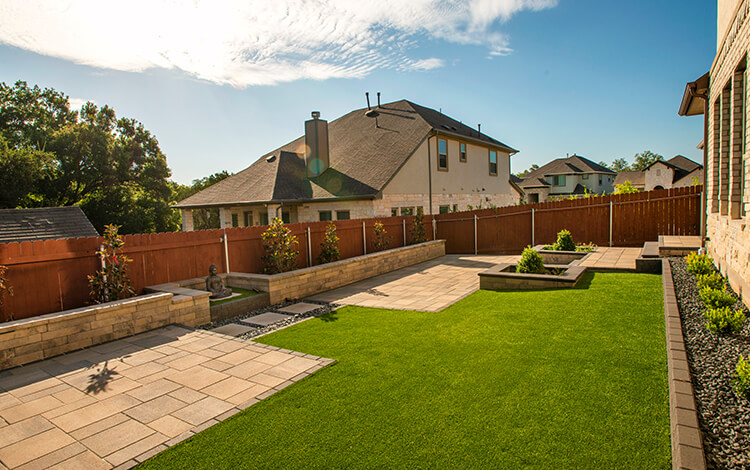
When a paver patio or a retaining wall goes wrong, it very rarely fails at the part you can see. The pavers are fine. The stone is fine. What moved is the ground underneath, and by the time you notice the dip near the back door or the wall leaning a few degrees out of plumb, fixing it means taking the whole thing apart.
North Texas clay makes this worse than it is in most of the country. Our soil swells when it takes on water and shrinks hard when it dries out, and it does both dramatically. Anything built directly on undisturbed clay is riding on a surface that moves with the weather. That's the same reason foundation repair is such a common trade around here.
A base that holds up starts with excavating deeper than most people expect — typically six to eight inches below finished grade for a patio, and considerably more for a driveway that has to carry vehicle loads. That depth gets filled with crushed aggregate, and the critical detail is that it goes in and gets compacted in thin layers, called lifts, of two to three inches at a time. Dumping the full depth in and running a plate compactor over the top only compacts the top few inches; everything below stays loose and waiting to settle.
Grade is the other half of it. A patio needs a deliberate slope — roughly an eighth of an inch of fall per foot — carrying water away from your house. It's a slope you won't perceive when you're standing on it, but without it you get puddles that sit for days, and in the worst cases water running back toward the foundation. On retaining walls the equivalent detail is drainage behind the wall: gravel backfill and a drain line so water has somewhere to go. Hydrostatic pressure from saturated soil is what pushes walls over, and it's entirely preventable.
Edge restraint is the last piece and the one most often skipped on cheaper installs. Without it the outer course of pavers gradually creeps outward, joints open up, and the field loses its lock. Once the perimeter goes, the middle follows.
None of this shows up in a finished photo, and that's exactly why it's the first thing cut when a bid is priced to win. When you're comparing quotes, ask what depth they're excavating, how the base is being compacted, and what edge restraint they're using. The answers tell you a lot.
We build patios, fire pits, retaining walls, driveways, and outdoor kitchens across Denton and Cooke counties. Call (940) 595-7965 for a free written estimate.